EIV analysed 252 vertical recommerce marketplaces and platforms across the US and Europe, which have collectively raised $10.8bn.
Electronics businesses have raised $2.8bn, Luxury $2.7bn, Fashion $2.2bn and Collectibles $1.3bn. Together, these four verticals account for around 83% of all capital raised in our dataset. Fashion has attracted the largest number of funded startups (65), while the median capital raised per startup is $10.0m in Luxury and $9.9m in Electronics, compared to just $2.9m in Fashion.
Below, we explore, what has led some recommerce businesses to raise so much more capital than others? And, what does this mean for the next wave of funding?
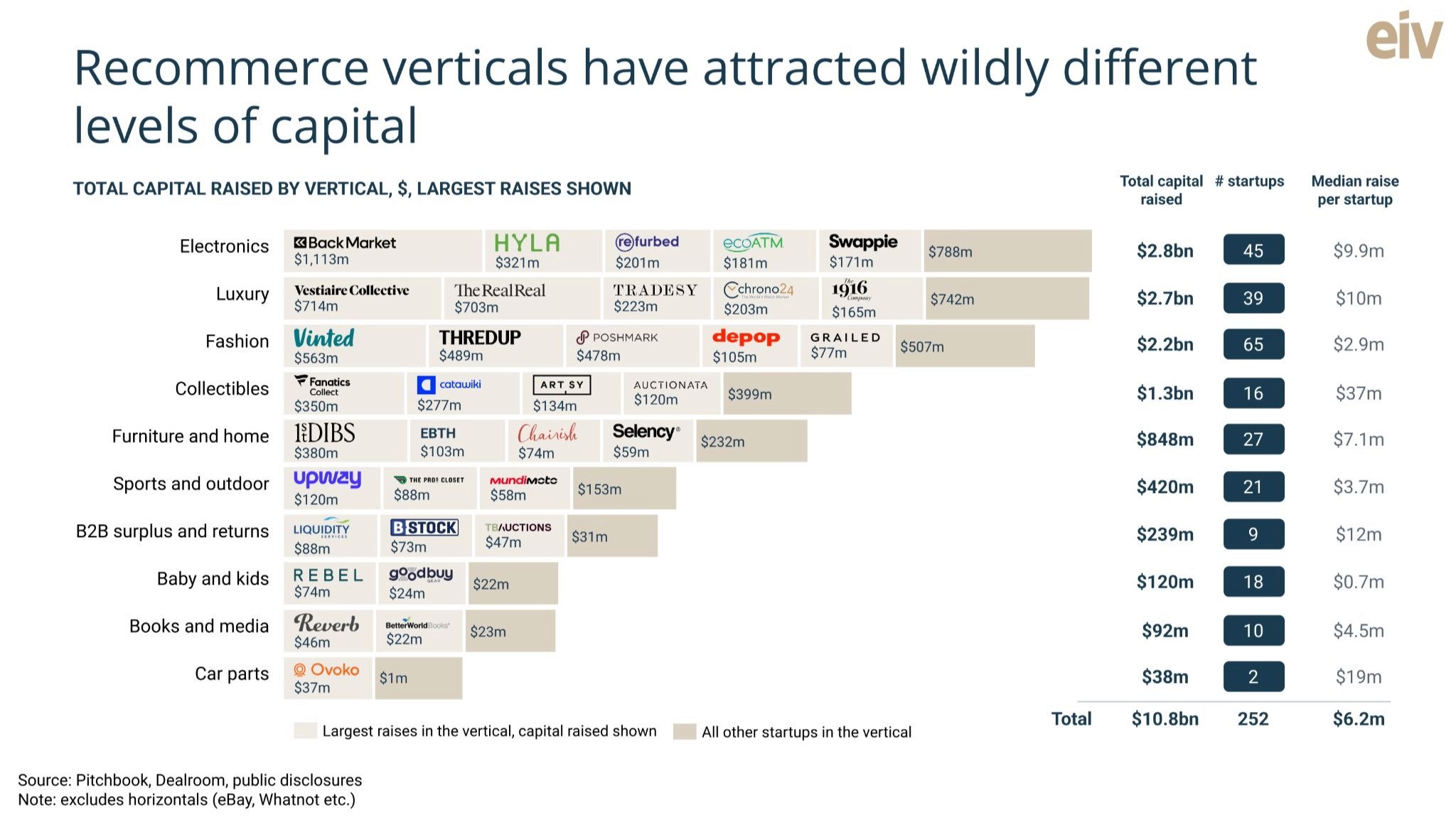
Luxury and electronics have absorbed more than half of all recommerce funding
Luxury and Electronics together account for $5.5bn, or 51%, of the capital raised in our dataset. They represent just one-third of the startups. The largest total capital raises also sit in these categories, including Back Market, Vestiaire Collective and The RealReal.
There are structural reasons why these businesses have raised so much capital.
In Luxury, the marketplace needs to establish trust around products where a single transaction can be worth thousands of dollars. Authentication, inspection, logistics, seller acquisition and customer service all become important parts of the proposition. Managed models such as The RealReal add another operational layer by physically receiving, processing, photographing, storing and fulfilling inventory.
For electronics recommerce platforms, items need to be tested, graded and often repaired or refurbished. Platforms may provide warranties and manage returns, while first-party models like Swappie also need to fund inventory before it is resold.
In both categories, the money raised has helped companies build the physical and technological infrastructure required to make difficult products reliably tradable online. This infrastructure can be expensive to build, but it can also become a moat, raising a high bar for any new entrant to reach.
Electronics has one clear funding leader, Back Market has raised > 3x as much as HYLA.
Fashion has produced more startups, but has required less capital per business
Fashion is the most crowded vertical in our dataset, with 65 funded startups. It has attracted $2.2bn of capital, materially less than Luxury or Electronics. The median Fashion player has raised just $2.9m, compared with $10.0m for Luxury and $9.9m for Electronics.
Interestingly, P2P marketplaces are not necessarily raising less money than managed ones. Vinted has raised $563m and Poshmark $478m, while managed marketplace ThredUp has raised $489m.
Vinted and Poshmark are predominantly P2P marketplaces, while ThredUp operates a managed model, receiving, processing, photographing, pricing, storing, and fulfilling goods itself. For P2P businesses, much of that investment has gone into building liquidity, acquiring users and expanding geographically - something the managed marketplaces have to do as well.
Collectibles have attracted deep capital
Only 16 businesses account for $1.3bn of funding, with companies including Fanatics Collectibles, Catawiki, Artsy and Auctionata attracting substantial amounts of capital. The median Collectibles platform has raised $37m.
Specialist marketplaces can create particularly strong network effects. Supply is particularly fragmented, products are differentiated, specialist knowledge matters, and buyers are often willing to transact internationally to access unique inventory. Trust, authentication, grading, transaction history and pricing data all become increasingly valuable as a marketplace scales.
Furniture & Home has proven particularly challenging
Furniture & Home has attracted $848m across 27 funded startups, with a median raise of $7.1m. But the category has proven particularly challenging. In our broader sample of 27 Furniture & Home businesses, 9 have failed, i.e. one-third.
The economics are difficult because furniture is bulky, purchased relatively infrequently and expensive to move. Storage, delivery and returns can quickly erode margins, while low transaction frequency makes it harder to spread customer acquisition costs across repeat purchases.
1stDibs launched in 2000 and has raised $380m. It reported its first positive Adjusted EBITDA quarter as a public company in Q4 2025, around 25 years after launch, while full-year 2025 Adjusted EBITDA remained negative.
The long tail of recommerce has attracted little capital
Baby & Kids businesses in our dataset have raised $120m across 18 startups. Books & Media has attracted $92m across 10 businesses, while Sports & Outdoor has raised $420m across 21. That amounts to median funding of $0.7m for Baby & Kids, $4.5m for Books & Media and $3.7m for Sports & Outdoor.
This does not necessarily mean these verticals have been overlooked, some simply support more capital-efficient businesses like Momox. Others have lower average transaction values, or weaker monetisation, making it difficult to deploy very large amounts of venture capital at attractive returns. While some categories face operational challenges without the high ASP unit economics of Luxury or Electronics.
A €3,000 refurbished e-bike can support inspection, repair and delivery in a way that a €30 secondhand children's toy cannot.
The next big rounds may look different
Looking at the most recent rounds, we see two areas where the next wave of recommerce funding could flow.
Successful platforms are raising to expand beyond their original category
Vinted has moved way beyond their original fashion vertical also to offer electronics, home, hobby and sports goods. Several recent rounds suggest that once a recommerce business has proved its model in one category, new capital is increasingly being used to take that model into adjacent ones.
Whatnot started with collectibles, particularly trading cards and Funko Pops, but has since expanded into hundreds of categories. In August 2026, it raised $545m in a Series G, almost doubling its valuation to $20bn. Fashion is now its largest category by order volume in the UK, while the platform continues to broaden well beyond its original collectibles base.
Refurbed raised €50m in October 2025, less than two years after its Series C. The business started around refurbished consumer electronics, but now also sells household appliances, e-bikes and other sports products. The latest round is supporting further geographic expansion and continued investment in technology as the business broadens beyond its original Electronics focus.
REBEL raised a $25m Series B in November 2025, less than a year after its Series A. The business started with returned and open-box Baby & Kids products, expanded into Home in 2025, and is now using the new capital to move into Outdoor and Sporting Goods, including camping, winter sports and athletic equipment. REBEL had processed more than one million products by August 2025 and said the new categories were only the beginning of a broader expansion across retail.
These platforms are raising additional capital after building supply, liquidity, trust or processing infrastructure that can increasingly be applied to other categories.
Managed recommerce models are becoming more attractive
A large share of the meaningful recent rounds has gone into managed marketplaces that deliver the end to end transaction.
Upway raised $60m in 2025 to expand its refurbished e-bike model. The business operates dedicated refurbishment centres where bikes are inspected, repaired and prepared for resale before being sold online.
In Electronics, EasyCep raised $45m in 2025. The company combines sourcing, refurbishment and resale, and is using the new capital to expand its dealer network and processing capacity.
GetMobil raised $22m in 2025 around an end-to-end model covering trade-in, refurbishment, pricing, inventory and resale. The company is also investing further in AI-driven diagnostics and instant pricing.
Underdog raised €7m in 2025 to scale the refurbishment of large household appliances, including investment in processing capacity.
Historically, investors have viewed managed recommerce models with caution. More transactions meant processing more physical items, requiring additional people, warehouse capacity and working capital.
However, with AI, the economics are now starting to look attractive. The RealReal is already using AI to automate parts of its intake process, while product identification, pricing, listing creation, authentication and customer support are all becoming increasingly automatable.
For managed platforms, these efficiencies have a direct impact on the cost of processing each additional item. As more of that work becomes automated, the operating leverage of the model should improve. We therefore expect managed recommerce businesses to become more attractive to investors as AI and automation improve their economics.
EIV is very active in the funding and sale of recommerce platforms and marketplaces. If you own one or are building one, we would love to hear from you.