Where will the next wave of recommerce exits come from?
Recommerce has produced some exceptional investor outcomes over the past decade, across fashion, electronics, luxury, collectibles and other specialist categories.
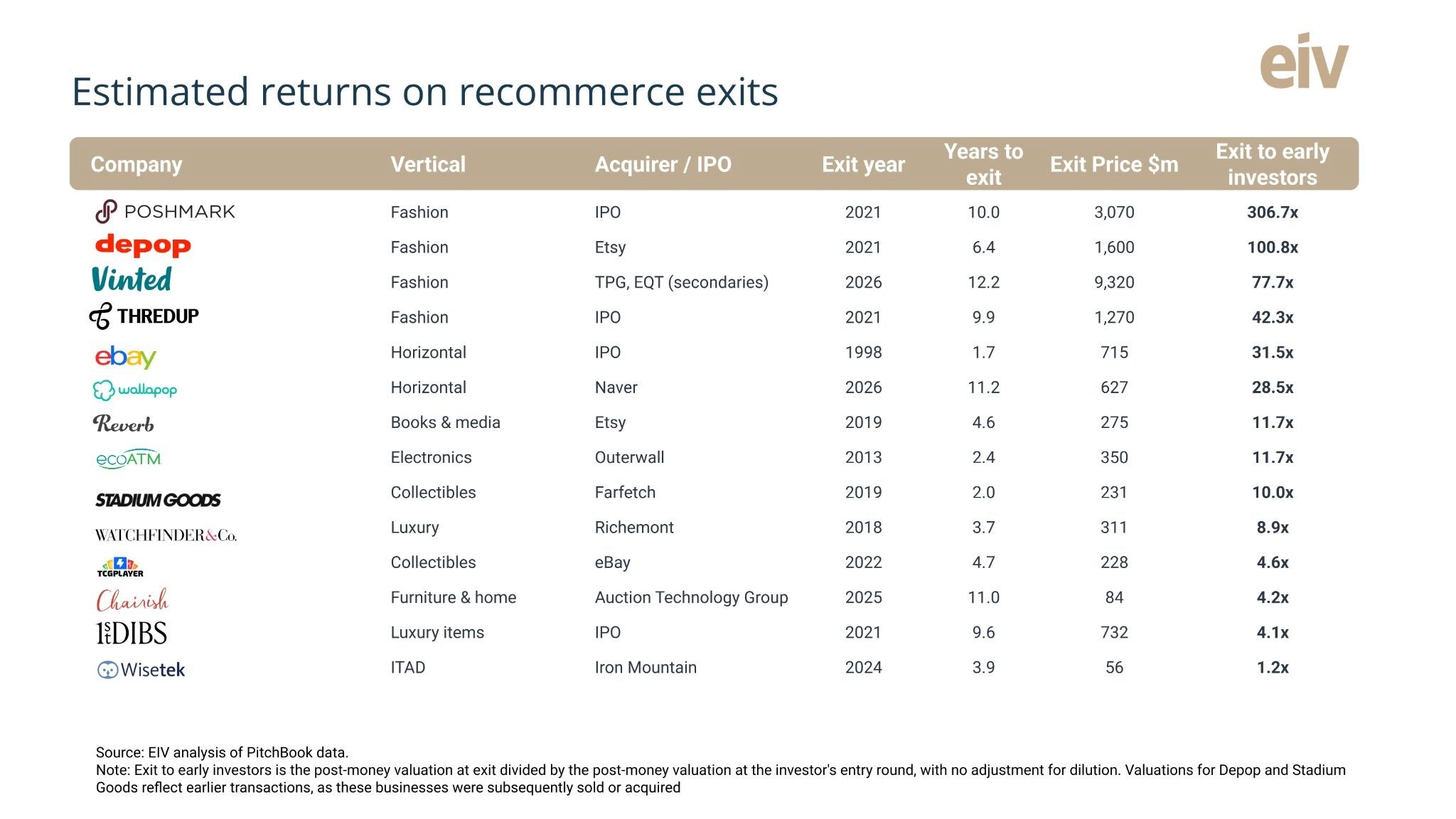
We analysed notable recommerce exits across the US and Europe and measured the increase in company valuation from an investor entry round through to the relevant liquidity event.
An investor entering Poshmark at its 2011 Series A valuation would have seen the company exit at 307x that entry valuation at its 2021 IPO. Depop reached 101x its 2015 Series A valuation when Etsy acquired the business six years later, while Vinted’s 2026 secondary transaction valued the company at 78x its 2014 Series B valuation. These are entry-to-exit valuation multiples, actual investor returns vary of course with dilution, follow-on investment and the timing of individual share sales.
The exit routes have evolved. The first major wave came through public listings and large consumer marketplace acquisitions. More recently, M&A has broadened into cross-border consolidation and capability-led acquisitions, with buyers using deals to add new geographies, supply, refurbishment, logistics and resale infrastructure. Large secondary transactions have also emerged as another source of liquidity for mature private businesses.
Looking across the strongest outcomes, several patterns stand out, and they give a useful indication of where the next wave of recommerce exits could come from.
IPOs created a major wave of recommerce liquidity
In 2021, several scaled consumer marketplaces reached public markets. Poshmark, ThredUp,and 1stDibs all listed that year. Only Poshmark was profitable at that time. An investor entering Poshmark at its 2011 Series A valuation would have seen the company IPO at 307x that entry valuation, while an investor in ThredUp’s 2011 Series B would have seen the business list at 42x, and 1stDibs reached 4.1x from its 2011 Series A.
These outcomes reflected the scale that recommerce marketplaces had reached after a decade or more building supply, buyer demand, trust and transaction liquidity. Fashion led the first wave, but similar models were already emerging across electronics, luxury, and specialist categories.
Strategic M&A has also produced strong outcomes
Strategic M&A was already active alongside the IPO market. Etsy acquired Depop for ~$1.6bn in 2021, equivalent to 101x the valuation at its 2015 Series A.
Strategic acquisitions have produced strong investor outcomes across a wide range of recommerce categories. Reverb, an online marketplace for new and used musical instruments, was acquired by Etsy for $275m in 2019, equivalent to 11.7x the valuation at its 2015 Series A. Stadium Goods, a marketplace for sneakers and streetwear, was acquired by Farfetch in 2019, at 10.0x its 2017 Series A valuation, while Watchfinder, a marketplace for pre-owned luxury watches, was acquired by Richemont in 2018, at 8.9x its 2014 growth round valuation. TCGplayer, one of the largest online marketplaces for trading card games, was acquired by eBay in 2022, at 4.6x its 2018 growth round valuation. More recently, Wallapop was acquired by Naver in 2026, priced at 28.5x its 2014 Series A valuation.
These transactions span musical instruments, sneakers, watches, trading cards and horizontal resale, with buyers acquiring established supply, liquidity and specialist capabilities.
M&A is also increasingly being used to add geography and operating infrastructure. Trove, which provides brands with resale technology and reverse-logistics infrastructure, acquired Berlin-based reverse.supply in 2025, adding a similar European platform and local brand relationships. While Recommerce Group has used acquisitions including Fenix.eco and Verkaufen.ch to build a broader European refurbished-electronics footprint.
The GCC is at an earlier stage of this consolidation cycle. Cartlow, a UAE-based recommerce platform for refurbished and pre-owned electronics, acquired Melltoo, a C2C marketplace for secondhand goods in 2022 and was subsequently acquired by circular technology and reverse-logistics business Basatne in 2025. The region now has well-established recommerce businesses across electronics (Revibe), luxury (The Luxury Closet) and horizontal resale (Dubizzle), creating a growing base for regional consolidation and strategic M&A.
Secondary liquidity is emerging as another exit route
Large secondary transactions are also creating liquidity for scaled private recommerce businesses.
Vinted is the clearest example. Its 2026 secondary transaction valued the company at ~€8bn, meaning an investor entering at its 2014 Series B valuation would have seen the business valued at 77.7x that entry valuation.
Back Market has followed a similar route. In 2024, a group of employees and existing shareholders sold around €70m of shares to new investors including Noteus Partners and AFIR. The transaction was reportedly oversubscribed, although the valuation was not disclosed.
As more private recommerce businesses reach scale and profitability, and until the next recommerce IPO wave begins (we are confident it will), we expect secondaries to become a more meaningful source of liquidity alongside M&A and public listings.
Where do we expect the next wave of recommerce exits to come from?
We expect the next wave of recommerce exits to be driven by three themes.
Consolidation
Recommerce remains fragmented across categories and geographies, creating significant scope for M&A. Recent transactions, including Trove’s acquisition of reverse.supply, Recommerce Group’s expansion across European electronics, and Naver’s acquisition of Wallapop, point to increasing cross-border and category consolidation.
We expect scaled regional players to become attractive targets for horizontal marketplaces, retailers and recommerce platforms looking to add supply, users, geography or operating capabilities.
AI will improve the economics of managed marketplaces
Managed marketplaces have historically carried high costs from receiving, identifying, authenticating, pricing, listing and fulfilling each item. AI can automate a growing share of this work.
The RealReal’s, for example, or example, AI systems like TRR Vision and TRR Shield to automate its intake process and cut processing costs. Similar applications across authentication, pricing, listing creation and inventory management should increase throughput and lower cost per item.
We believe the most AI-savvy managed marketplaces will become some of the great creators in recommerce. They have spent years building supply, trust, data and physical infrastructure, while AI now provides an opportunity to materially enhance the economics of those assets.
A large private cohort is reaching maturity
Many of today’s leading private recommerce businesses have now spent a decade or more building scale.
Vinted and Back Market have already demonstrated the potential for substantial secondary liquidity, while businesses including Vestiaire Collective, Refurbed and Swappie are reaching scale while improving their economics.
This creates a growing pool of businesses capable of supporting strategic acquisitions, large secondary transactions and, eventually, public listings.
EIV is very active in the funding and sale of recommerce marketplaces. If you own, operate or invest in one, we would love to talk.