Portals have sat at the centre of the property transaction ecosystem because they excel at aggregating inventory, consumer attention and leads. But a growing stack of AI-native software, discovery tools and transaction platforms is now offering agents, sellers and buyers alternative ways to generate demand, discover properties and complete transactions without relying as heavily on portals.
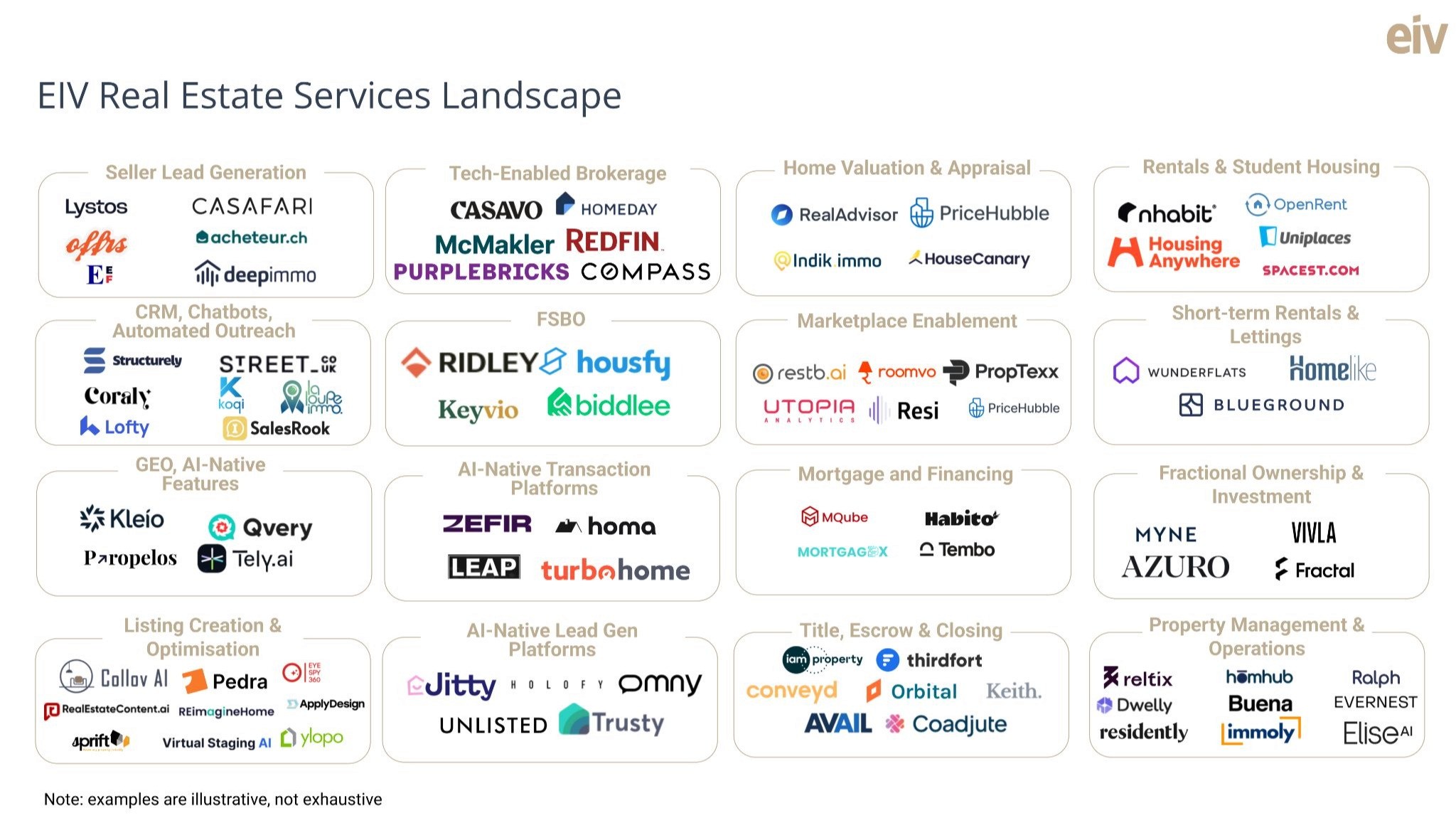
EIV has mapped > 80 tools, enablers and services platforms across the real estate technology landscape who are helping to make this shift possible. What did we learn?
Agents are becoming more capable without the portal
Historically an agent won an instruction, created the listing, uploaded it to the major portals and waited for enquiries to arrive. The portal provided the bulk of buyer enquiries while the agent managed everything that happened after the lead.
AI has brought real estate agents a new generation of tools and services likely to make those who adopt them considerably more autonomous and efficient, with implications for real estate agents and portals alike.
CRM, chatbots and automated outreach
Modern CRM systems and chatbots are helping agents automate the customer relationship and activate their existing client databases. An agent who can use AI to identify a likely seller off-portal, and nurture that relationship has lessened its reliance on the portal.
Brokerages sit on valuable assets: years of buyer, seller, property and interaction data. Historically, much of that data sat passively inside a basic CRM system. AI-first CRMs continually look for and activate relevant leads from the agent’s database every time a relevant listing goes live.
Platforms such as Structurely, Street.co.uk, Coraly, Koqi, and Lofty are doing exactly this.
Lofty can analyse an agency's existing CRM to identify customers most likely to be a match. The service automates outreach across multiple channels and recommends next steps. Other tools respond to enquiries, qualify buyers by budget, purchase time horizon and financing readiness. They are then matched against relevant properties with automatic follow up on viewings and potential offers.

The CRM is evolving from a system of record into a source of proactive demand and a tireless assistant.
Creating and marketing inventory is getting easier and cheaper
AI-powered Listing creation tools are drastically reducing the cost and effort of preparing property inventory.
Companies such as Collov AI, Pedra, ApplyDesign, RealEstateContent.ai, ReimagineHome and Virtual Staging AI can help with listing content creation, staging, imagery, virtual tour enablement and other marketing assets at a fraction of the cost of human support. Even when agents already performed the tasks themselves, AI-enhanced listing creation and enhancement tools are saving them considerable time while delivering a superior product.
Generating leads beyond the portal
Other companies on our landscape help generate the buyer / seller opportunity itself. If technology can identify or generate those leads elsewhere, then the portal has more competition for the agent's acquisition budget.
Seller lead generation
Platforms such as Offrs, Casafari and DeepImmo help agents identify homeowners who may be preparing to sell or sellers who might be looking for a new agent. These signals can come from AVM interactions, website engagement patterns, monitoring properties with price reductions or properties on the market for a long time, or an agency's CRM and third-party datasets.
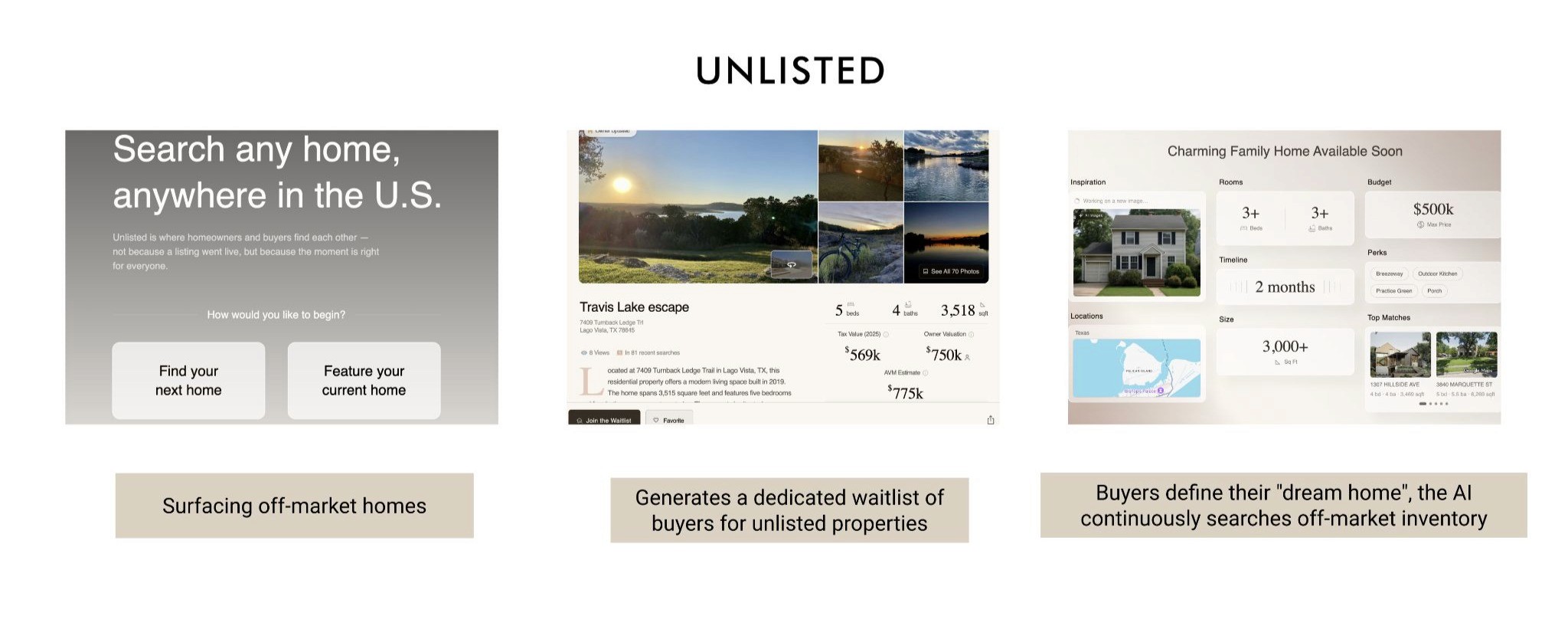
Unlisted starts with generating buyer demand for off-market properties. Buyers can express interest in homes that are not currently for sale and build a waitlist around a property. That latent demand can then be surfaced to the homeowner, potentially creating a seller opportunity before they had planned to go to market.
Buyer lead generation
Platforms such as Jitty, Omny and Holofy are rebuilding property search around natural-language and intent rather than the rigid filters that have characterized portal search for decades (now changing).
Instead of asking buyers to choose location, price, bedrooms and property type, these products can increasingly understand questions such as:
Find me a three-bedroom home with natural light, within 30 minutes of my office, close to a good primary school and in an attractive area that should be easy to resell in five years.
Buyers can essentially search for qualitative property characteristics, neighbourhood attributes, commuting requirements and other factors that are difficult to express through conventional filters.
The commercial model can also look very different from a traditional portal. Jitty, for example, removes the traditional subscription barrier for agents, with properties listed for free and monetisation pushed toward downstream services. Omny connects conversational buyer intent with the live inventory of professional agents and aims to deliver fewer, more qualified enquiries rather than a high volume of low-context leads. Without exception these platforms currently generate several orders of magnitude less traffic than the leading portals.
AI-native property discovery
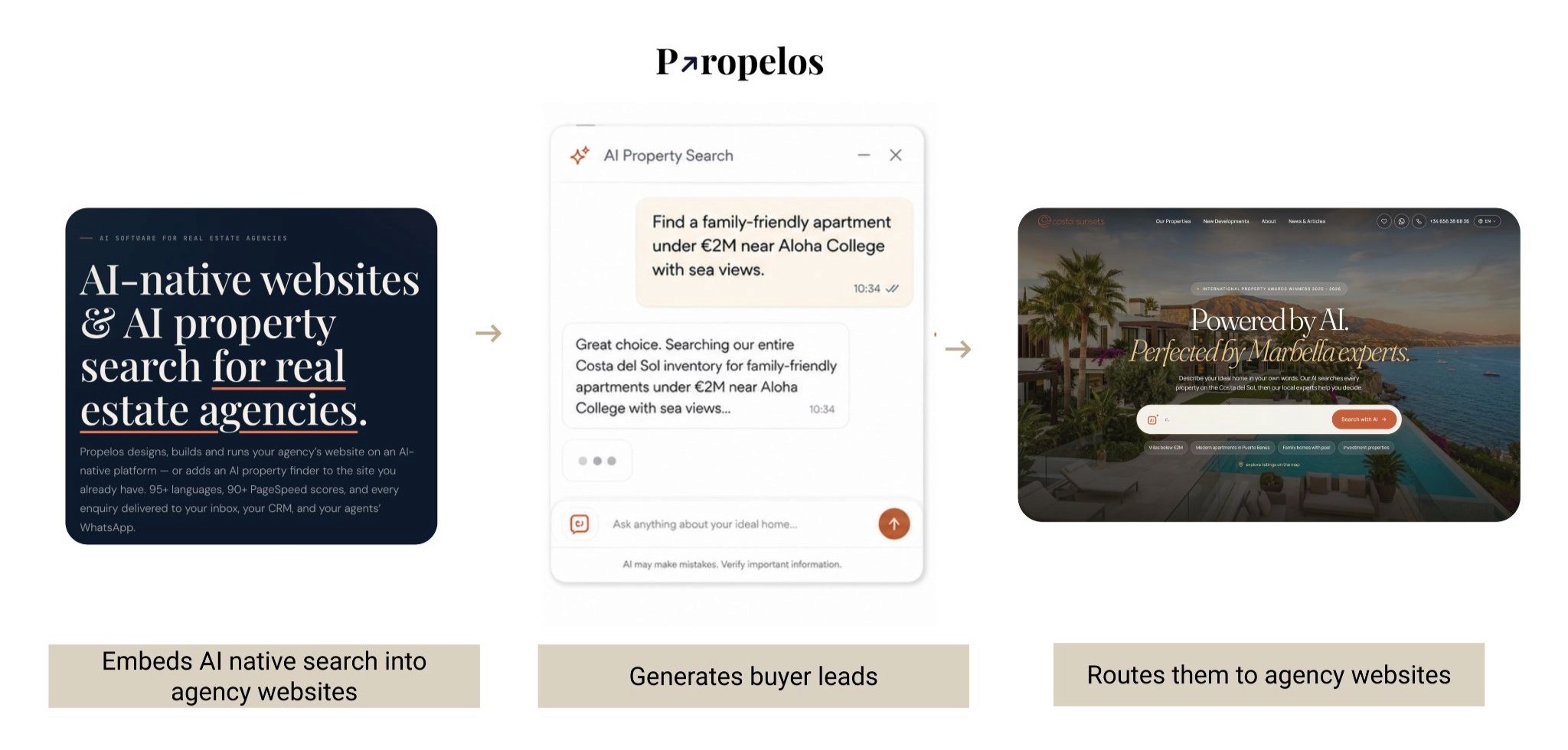
With many consumers beginning their property journey inside ChatGPT, Gemini, Claude or Google AI mode, real estate agents get an alternative high volume channel to capture leads beyond portals. Companies working on GEO, conversational search and AI-native discovery, include Propelos, Qvery, Tely.ai, and Kleio.
Propelos, embeds natural-language property search into agency websites and optimizes the agency website for GEO. Qvery tracks whether an agency or its listings appear in relevant AI searches and maps the sources AI engines cite. Tely.ai creates hyper-local content intended to generate traffic from both conventional and AI search. Kleío goes further by turning agency databases into AI-readable knowledge layers and connecting structured, live inventory into LLM interfaces.
The most ambitious AI-Native platforms want to own the transaction
AI-native transaction platforms
The previous generation of tech-enabled brokerages - Casavo, McMakler, Purplebricks, Redfin and Compass, promised to liberate the real estate agency from the high street and use technology to bring efficiencies. They moved processes online, introduced flat-fee packages and built better agent software.
Nonetheless, the economics of acquiring sellers and buyers remained expensive, transactions remained people-heavy, and the service quality was difficult to standardise across hundreds or even thousands of individual agents.
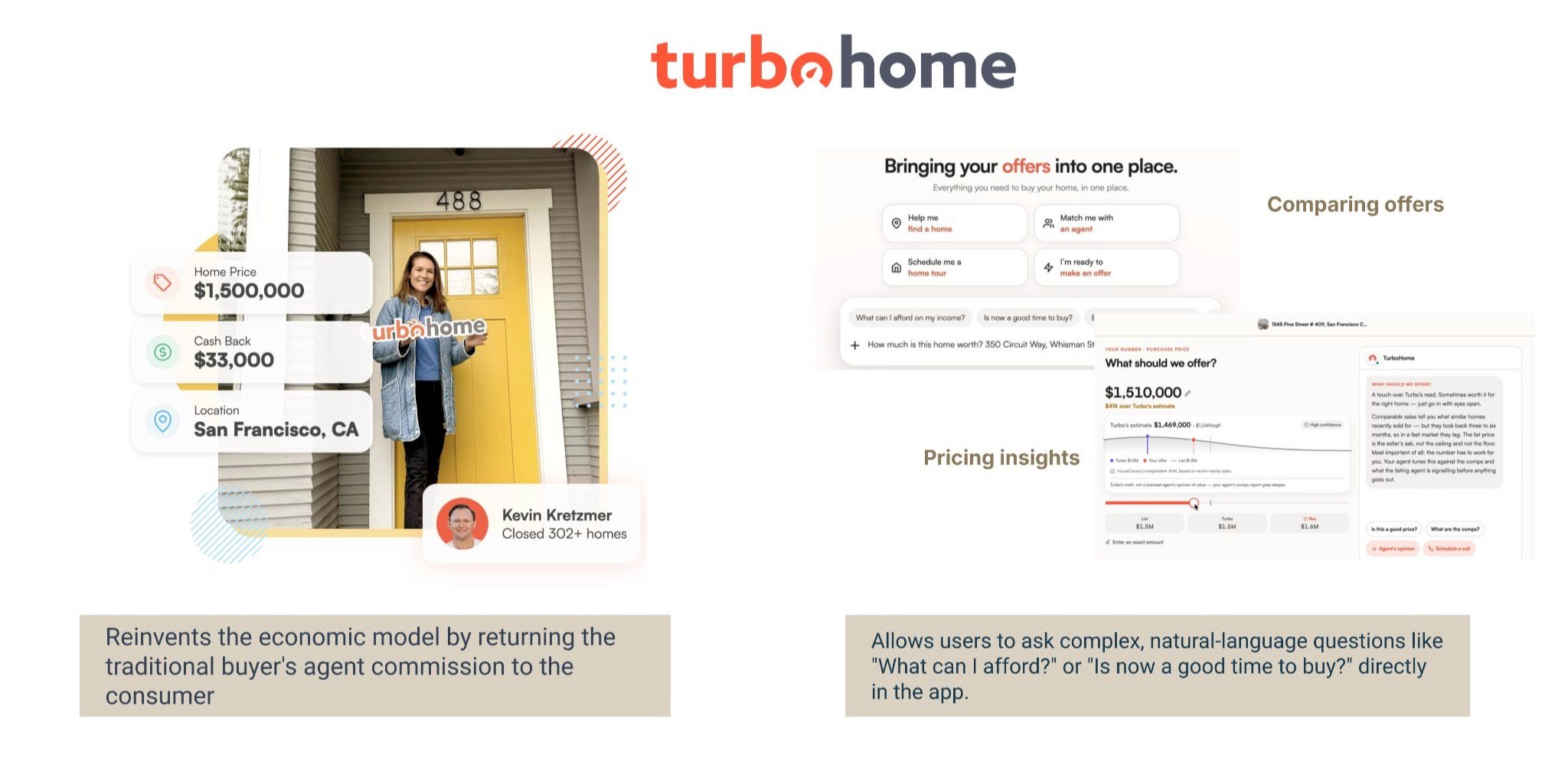
AI potentially changes that equation. An AI-native brokerage can automate more of the work. Platforms such as Turbohome and Homa combine AI-native search, property analysis and transaction coordination while human agents get involved only where they add the most value.
Turbohome, backed by FJ Labs and Sequoia Capital, combines a conversational buyer copilot with an economic model that returns part of the traditional buyer-agent commission to the consumer. The model is most suited to the US where 3% buyer fees and 3% seller fees are the norm.
AI-native transaction marketplaces
Rather than building its own real estate agent workforce, a platform can provide the software, matching and transaction layer while relying on an existing distributed network of independent agents to bring properties for sale (and part of the demand).
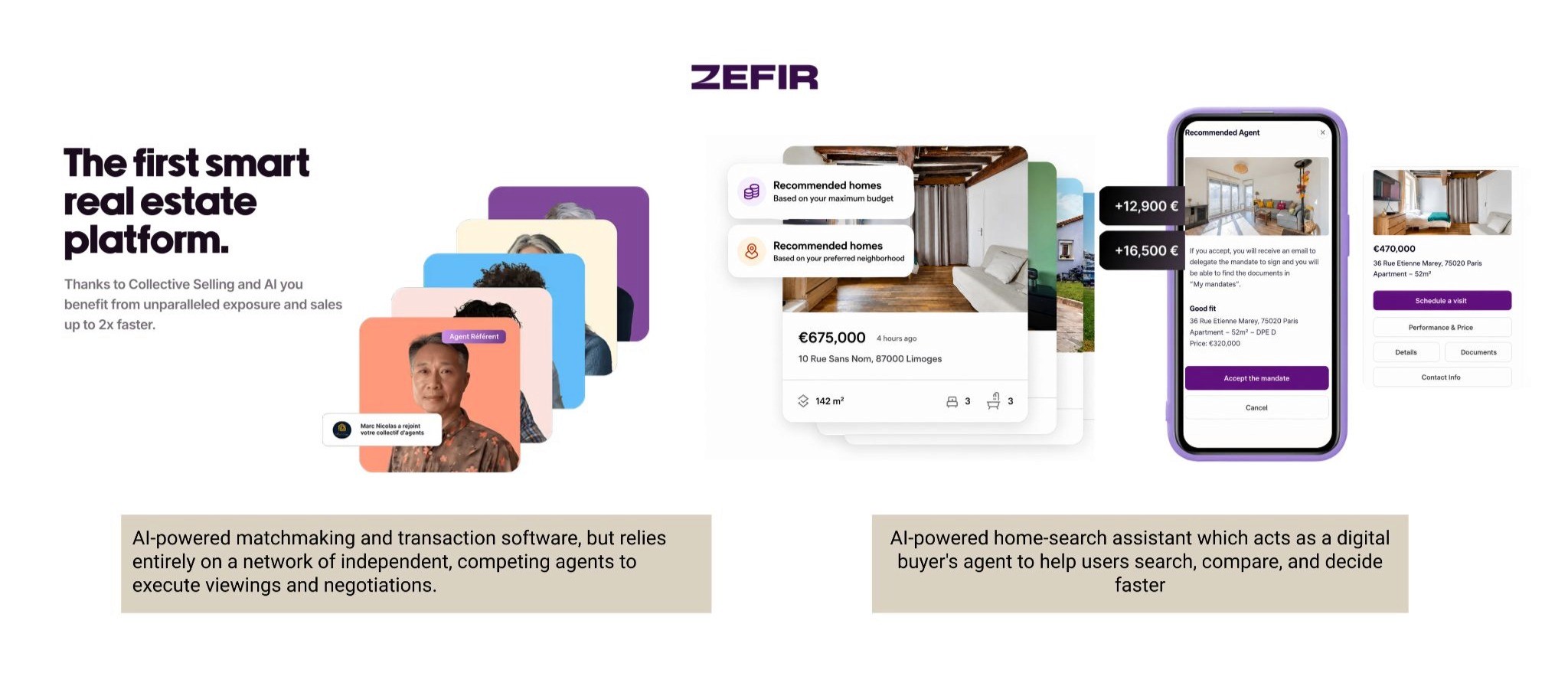
Zefir (founded 2020) is an example; it pools listings and buyer demand across third party agencies, while its AI-powered buyer assistant helps consumers search, compare and decide. The transaction itself is then executed through real estate agents in the network.
FSBO
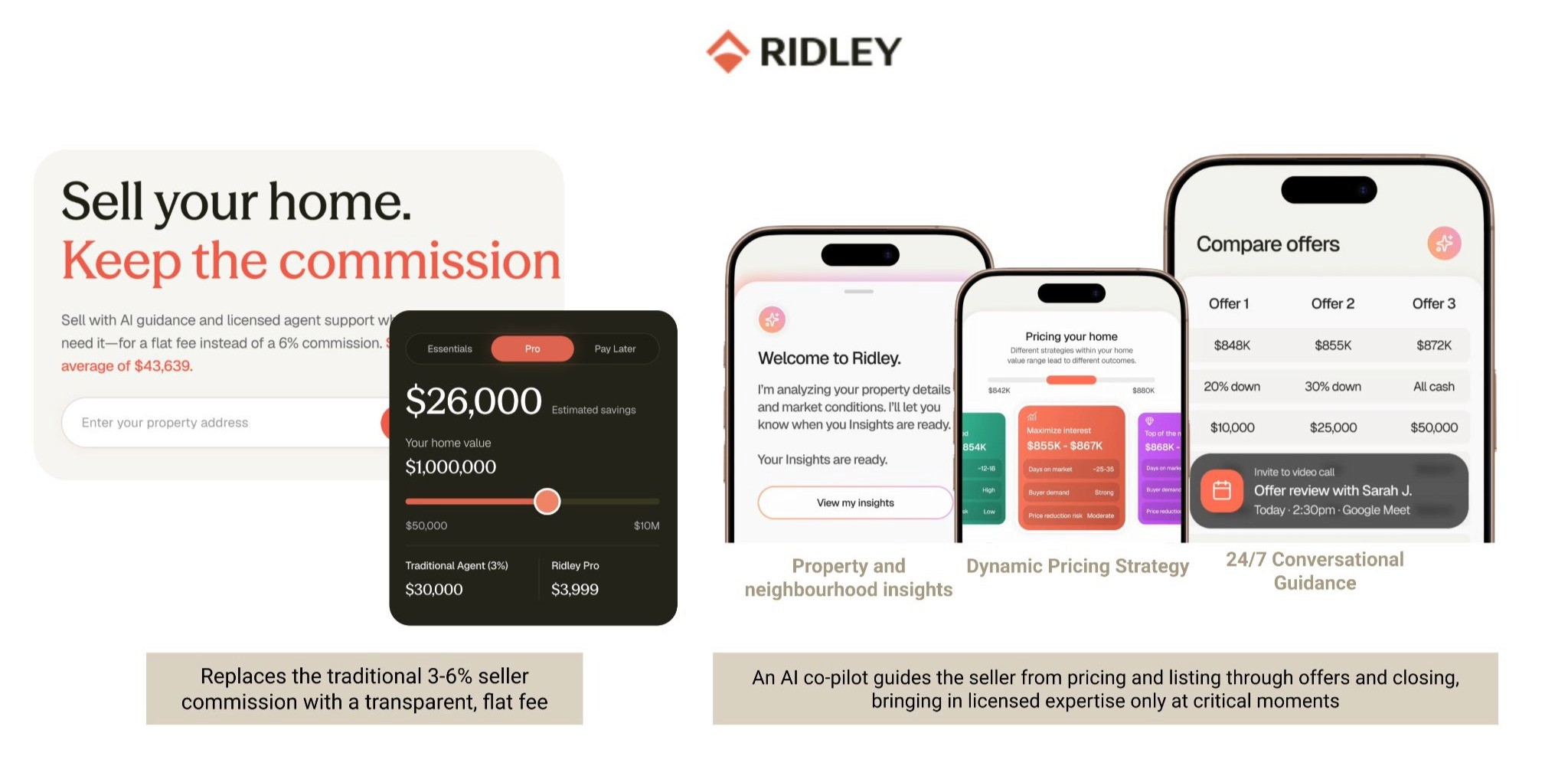
FSBO 1.0 was essentially a sign for homeowners to place outside their property and list their home online via the FSBO platform. The owner was largely on his/her own when it came to pricing the property, preparing the listing, managing enquiries and viewings, negotiating offers, preparing paperwork and coordinating the closing.
In contrast, an AI-native FSBO platform can help price the home, create the listing, answer questions, coordinate viewings, compare offers and guide the seller through the process. As a premium add-on, a licensed professional could also be available live or via chatbot where distilled advice is most needed.
Ridley, founded in 2025, replaces a percentage-based seller commission with a modest flat fee, while an AI copilot guides the seller from pricing through offers and closing. Professional support is also available on the Pro plan. Meanwhile, Beycome is extending the owner-led selling model into a broader transaction platform: its 24/7 AI assistant, Artur, helps homeowners create listings, analyse live comps, compare offers and review contracts, while Beycome Title keeps the closing process visible through a dashboard.
What does the next decade look like for real estate agents?
AI is likely to transform the real estate agent landscape. Agencies that fully embrace the capabilities set out above, are likely to gain market share while lowering their operating costs.
If a top agent equipped with AI can respond instantly, understand every lead, maintain thousands of warm leads, produce better marketing and manage more concurrent transactions, there is progressively less room for an agent completing a handful of transactions a year with limited differentiation.
Over the next decade, transaction volume is likely to consolidate around a smaller number of highly productive agents who use AI across prospecting, customer management, search, marketing and transaction execution.
In our view, many incumbent agents will adopt these tools fast enough to boost their businesses, while part-time and more traditional agents will find it harder to compete. A new generation of tech-enabled brokerages may use AI to automate enough of the transaction to finally deliver the economics that TEB 1.0 promised.
Meanwhile, many of the traditional portals are racing to embed much of the innovation showcased above and package into current and enhanced subscriptions. The pace of AI innovation in real estate marketing and transactions is not only benefitting real estate agencies.