Europe is beginning to see a new category of AI-native accounting roll-up: businesses that acquire, partner with or build accounting practices, keep the recurring client relationships, and rebuild the delivery model around shared software, automation and AI. Instead of selling tools to accountants, these platforms aim to own the underlying accounting, tax and payroll revenue, while using AI to drive a step change in both service sophistication and employee productivity.
The model is a new version of the traditional roll-up. Acquired practices bring trusted local brands, professional expertise, recurring customers and years of financial data. The platform brings capital, shared operations and AI that can automate document processing, bookkeeping, reconciliations, payroll preparation, tax workflows and client reporting. By meaningfully increasing capacity per employee, AI can transform the economics of consolidation.
We are already starting to see this model play out at a meaningful scale in property management: Dwelly in UK lettings and Buena in German residential property management are acquiring fragmented local operators and moving them onto proprietary AI platforms.
Accounting has many of the same characteristics: a large and fragmented market, recurring client relationships, repeatable workflows and thousands of owners approaching retirement.
Across the EU-27, accounting, bookkeeping and tax advisory generated €190.7bn of revenue in 2024, spread across 621,600 enterprises. Add the UK, at approximately €58bn, and the European market approaches €250bn (Eurostat, SBC).
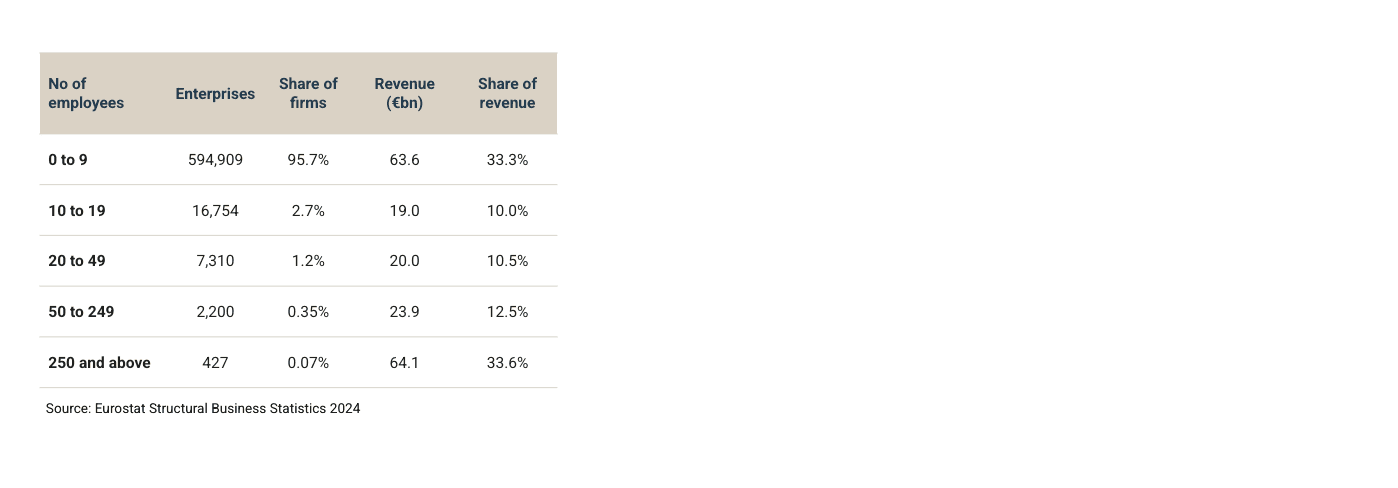
Yet the typical provider is tiny. The average EU accounting business generates only around €307k of annual revenue and employs 3.3 people.
More importantly, 98.4% of European accounting firms employ fewer than 20 people. Together these firms account for €82.6bn of revenue.
This is a very large market with an unusually fragmented supply side.
The opportunity looks different market by market
The major European markets vary significantly.
This is a very large market with an unusually fragmented supply side.
The opportunity looks different market by market
The major European markets vary significantly.

Germany is the largest continental revenue pool, with €50.1bn of revenue across 56,139 firms. France has fewer, larger practices, averaging around €1.2m of revenue and 9.4 employees. Spain is at the opposite extreme, with 65,477 firms averaging only €211k of revenue and 2.7 employees.
The UK contributes another approximately €58bn of revenue, while Poland adds €7.8bn.
Buying ten French firms can create a materially sized platform. Building the same revenue base in Spain or Poland requires considerably more acquisitions.
At the same time, the supply of accountants is getting tighter
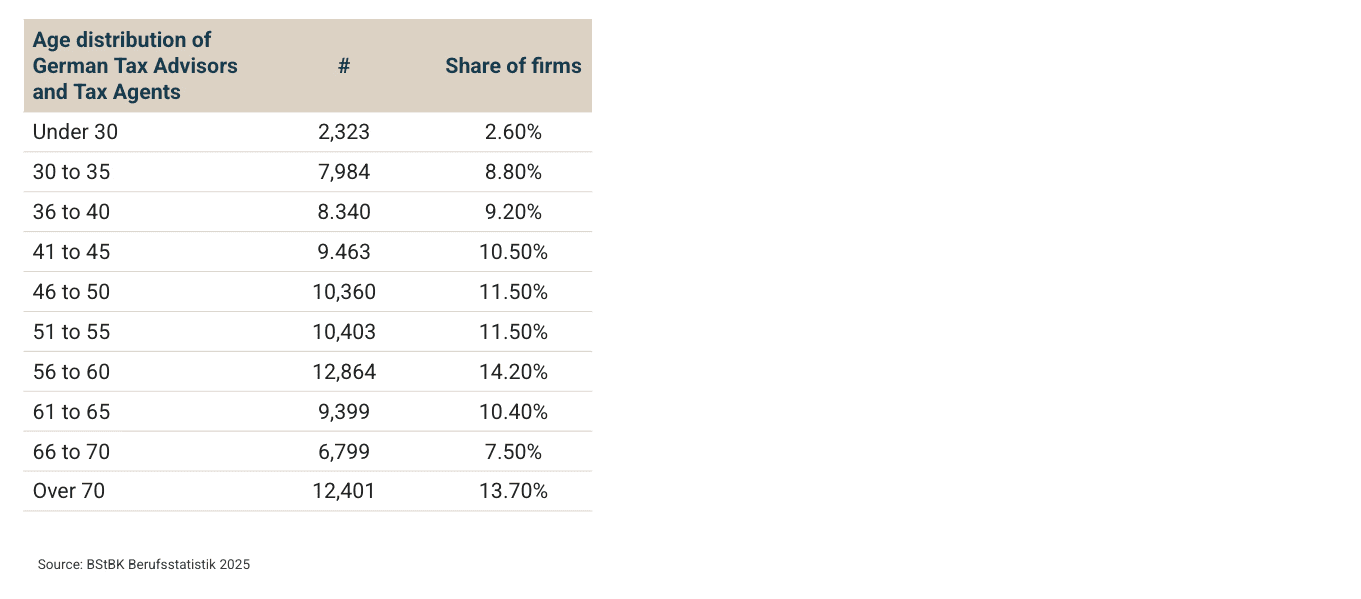
In Germany, 32% of licensed tax advisers are 61 or older, including 13.7% who are over 70 and remain on the register. Only 2.6% are under 30.
Replacing them with qualified humans is becoming increasingly difficult.
AAmong German sole practices trying to recruit, 59% of open positions went completely unfilled. Only 23% of practices managed to fill all their vacancies (STAX 2024).
For many practice owners approaching retirement, the alternatives are therefore narrowing. They can invest in new technology, recruit into an increasingly difficult labour market, find a younger partner willing and able to buy the business, or sell.
This creates a natural supply of acquisition opportunities.
Why AI changes the consolidation equation
Across Europe, tax and accounting workflows are becoming more structured and digital.
Poland introduced KSeF during 2026. France begins its e-invoicing rollout in September 2026. Germany already requires businesses to be capable of receiving structured invoices, with issuing obligations being phased in. Spain is implementing Verifactu, followed by its broader Crea y Crece requirements.
This should progressively make the underlying compliance work more standardised and machine-readable.
The opportunity is to combine consolidation with automation.
Accounting roll ups acquire fragmented client relationships and recurring revenue, then use common technology and increasingly structured financial data to handle more of the repetitive work across a larger client base.
AI potentially changes the roll-up from a financial engineering exercise into an operating model transformation.
A new generation of accounting platforms is emerging
Archipel, France
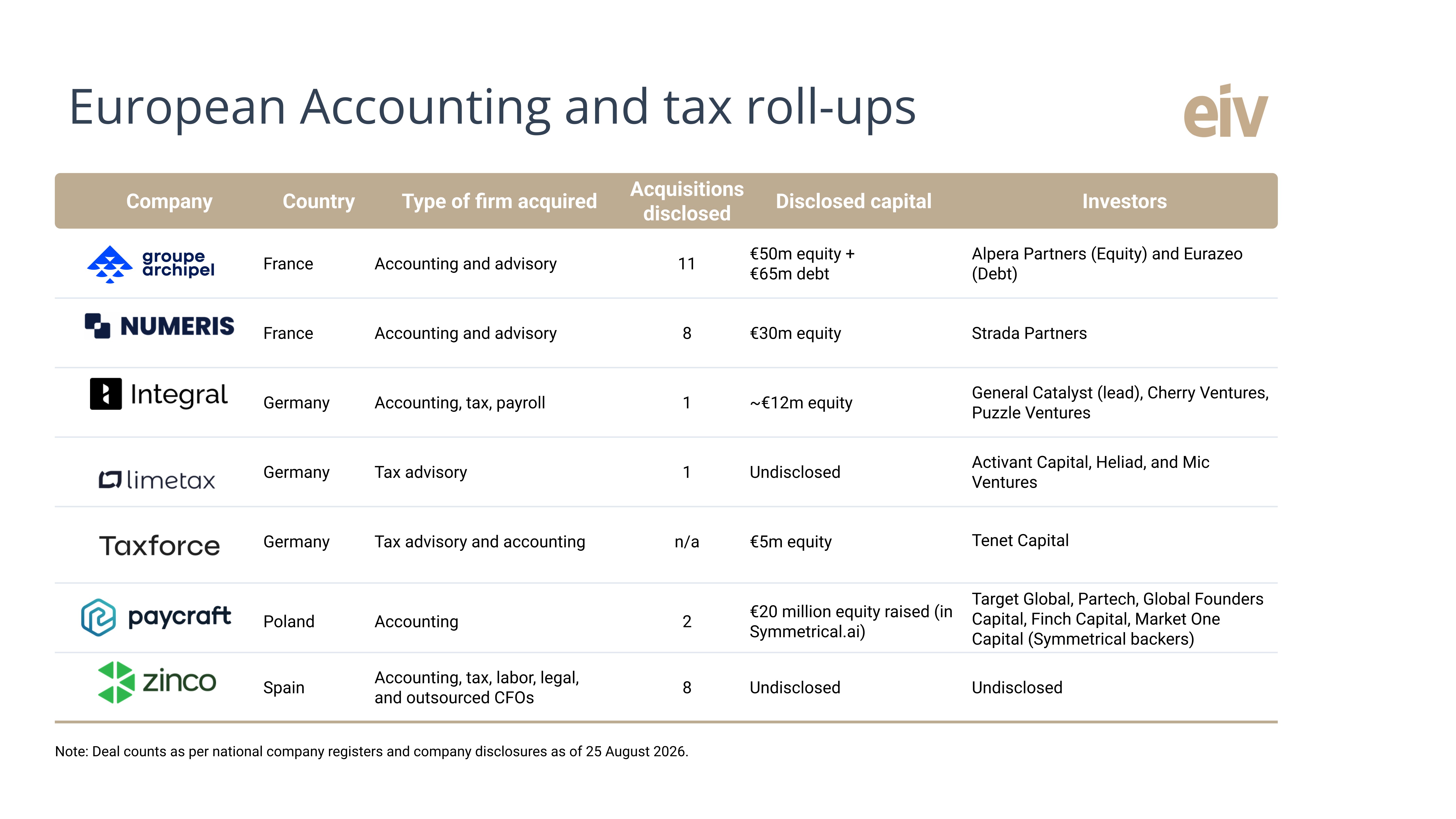
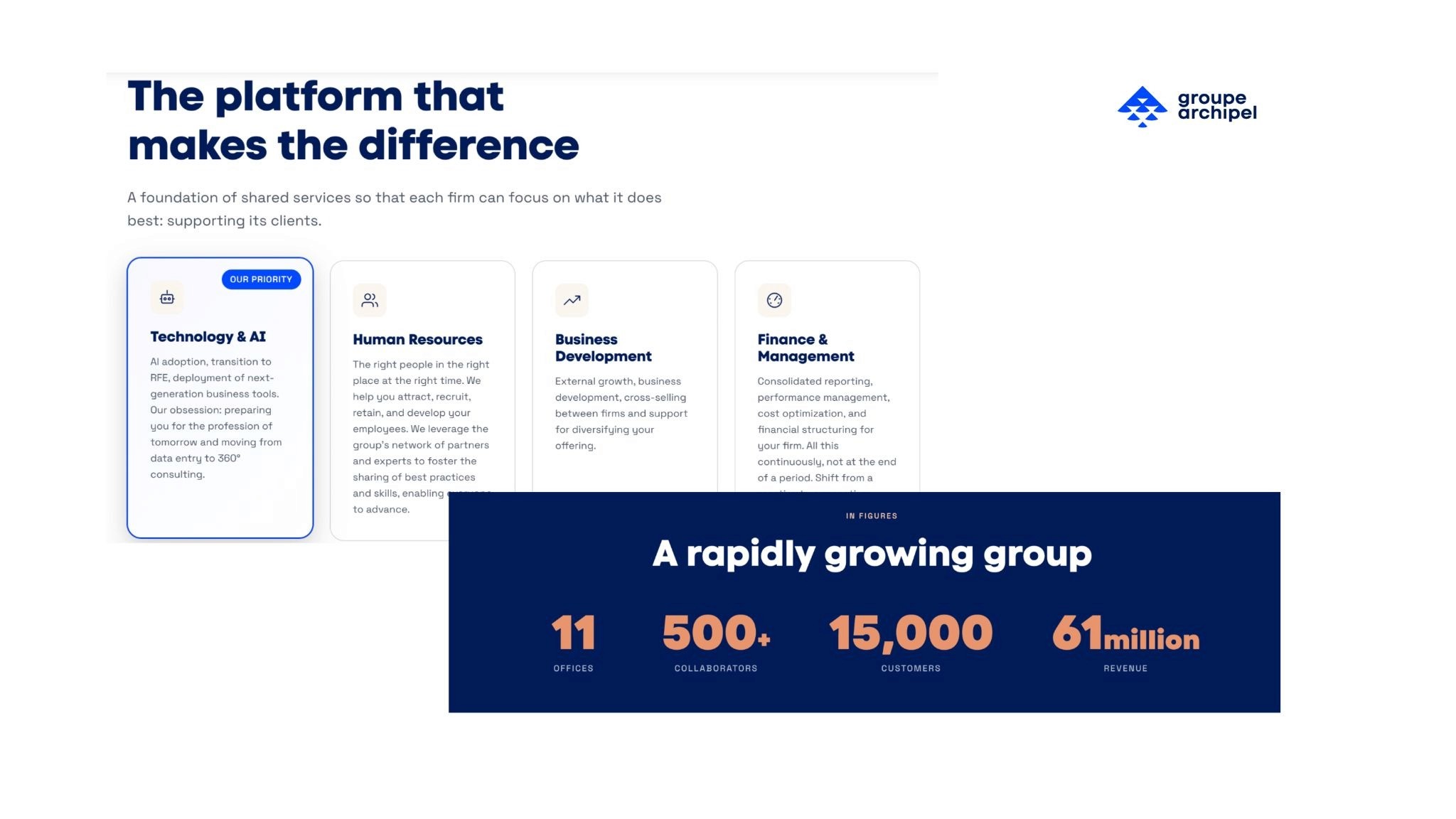
Archipel, founded in 2025, acquires majority stakes in French accounting firms.The firms keep their brand, local teams, partners and client relationships, while Archipel provides shared support across technology and AI, recruitment, business development and finance.
It has acquired 11 accounting practices and raised €50m of equity (Alpera Partners) plus €65m of debt financing from Eurazeo.
Numeris, France
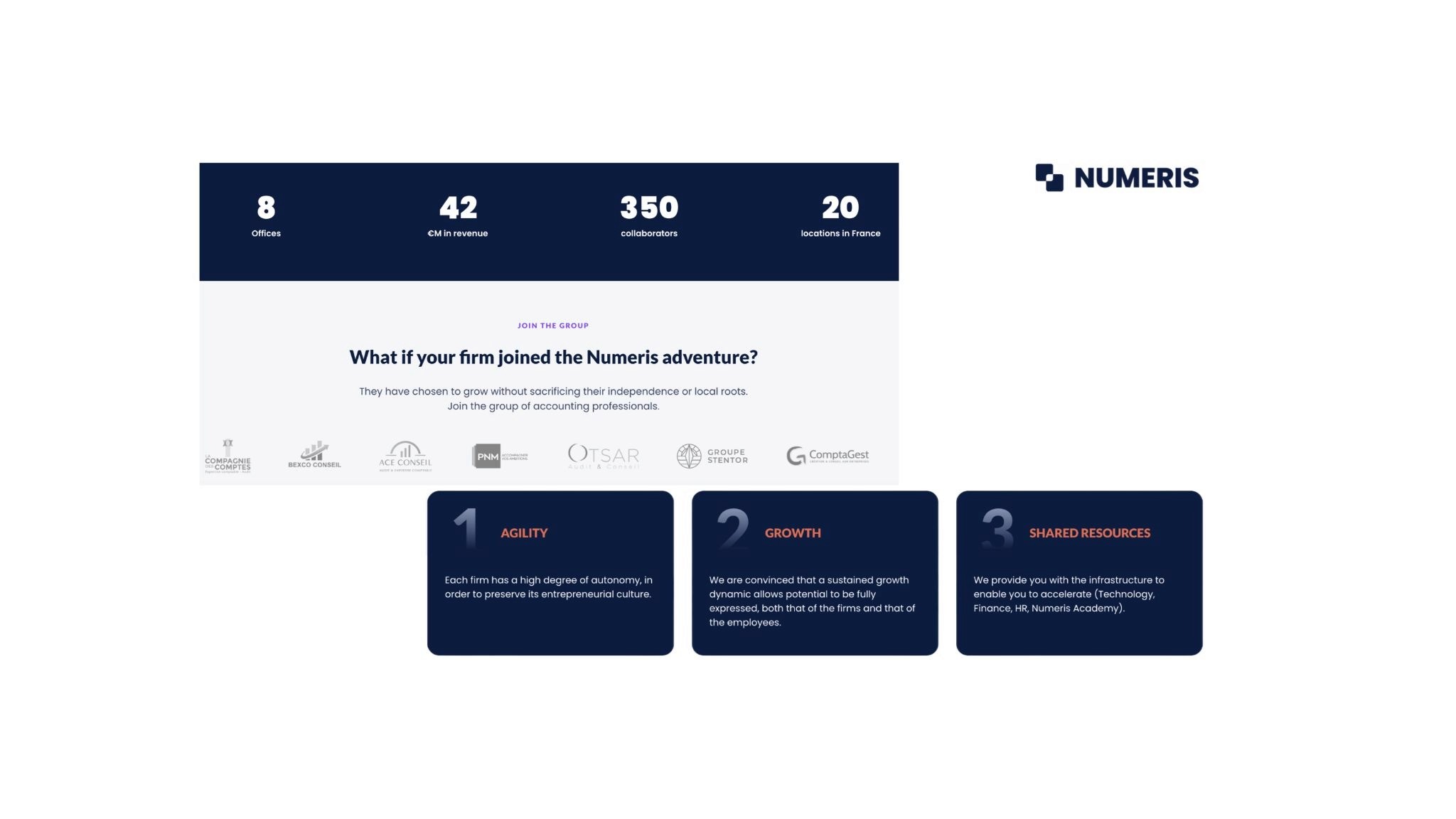
Numeris, founded in 2024, follows a similar partner-led model. The practices retain their local identity and professional autonomy, while Numeris provides shared support functions, digital strategy, automation, training and commercial development.
It has completed eight acquisitions, backed by €30m of equity from Strada Partners.
Zinco AI, Spain
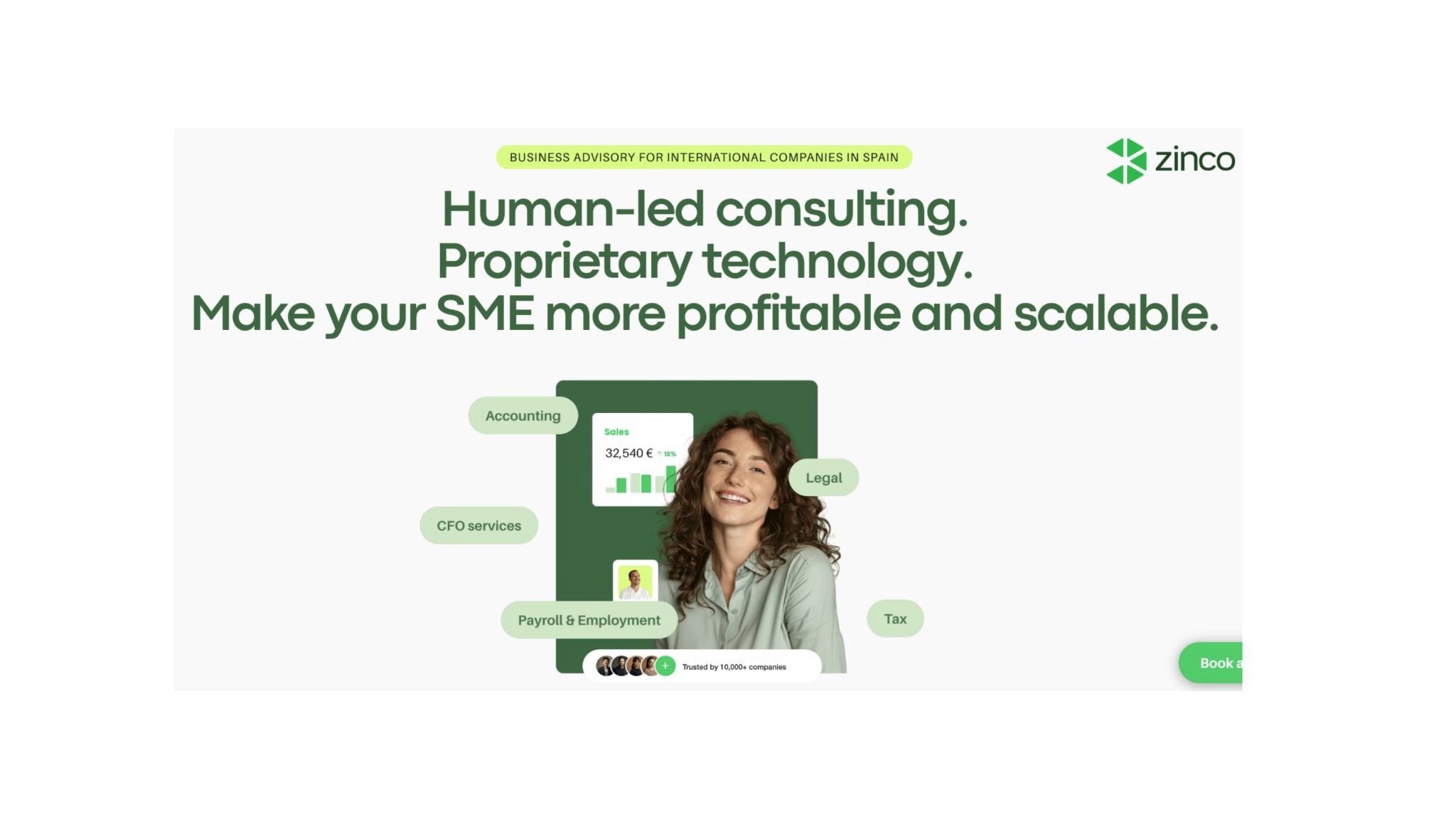
Zinco, founded in 2025, is building a national back-office platform for Spanish SMEs. It combines accounting, tax, payroll, legal and outsourced CFO services on one platform. Clients keep a dedicated human adviser, while Zinco connects its platform to banks, ERPs and tools such as Holded and Factorial to automate workflows.
Zinco has acquired eight asesoría (a consultancy or advisory firm that provides essential administrative, tax, accounting, and payroll services) in Spain.
Limetax, Germany
Limetax, founded in 2025 by the ex Razorpay CFO, is building an AI-powered tax advisory roll-up in Germany by acquiring and partnering with traditional Steuerkanzleien (tax advisory practices). The local firms join the group while Limetax provides shared technology and central support across areas such as recruiting, HR, sales, marketing and practice management.
Its proprietary AI platform sits on top of DATEV, the core software used by many German tax practices, so acquired firms do not need to replace their existing systems. Limetax is developing agentic AI tools that can handle multi-step workflows including document processing, account reconciliation, tax research and parts of annual financial statement preparation.

Integral, Germany
Integral has raised approximately €12m of equity, with investors including roll up trailblazers General Catalyst, Cherry Ventures, and Puzzle Ventures.
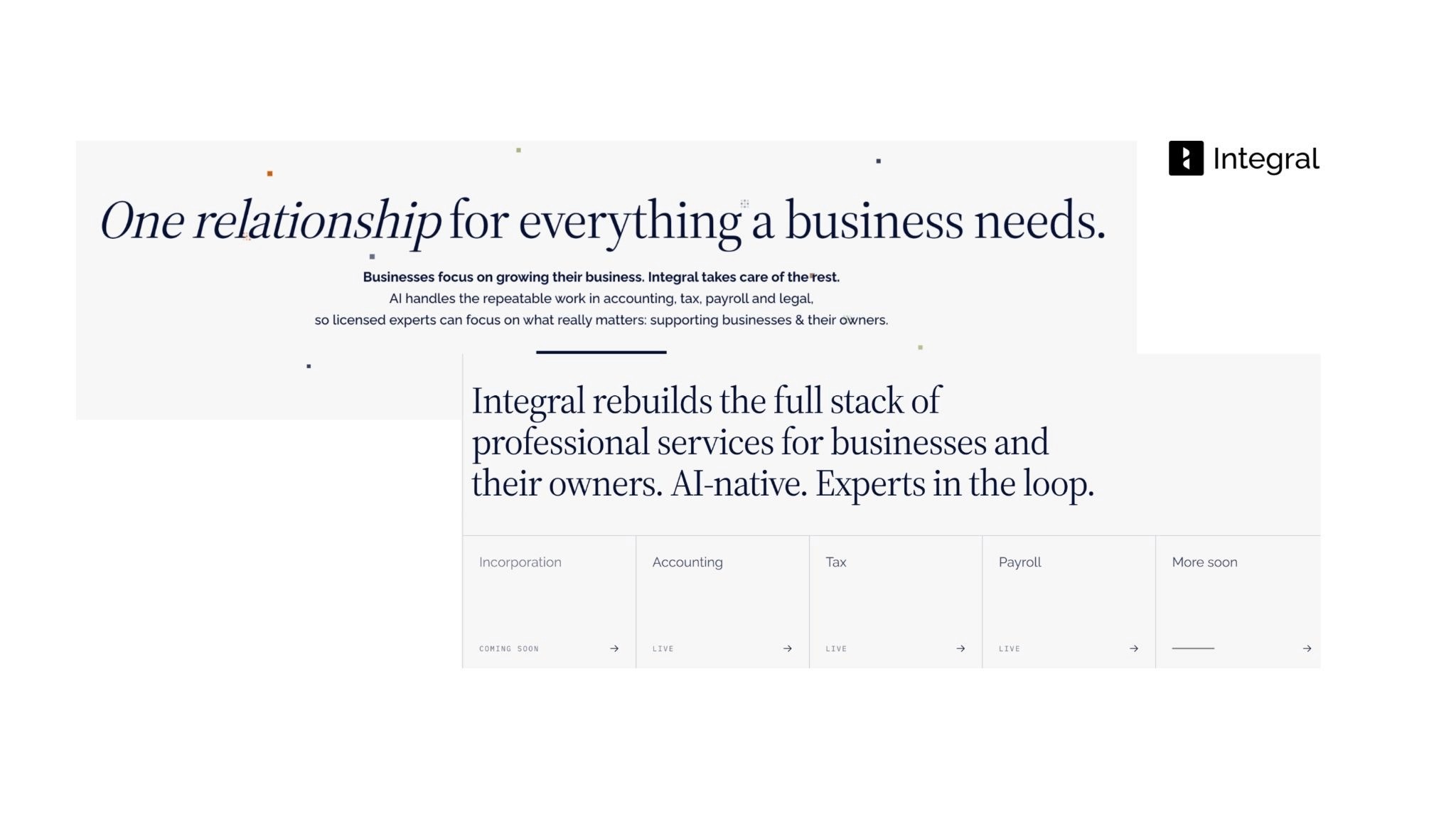
Rather than replacing the underlying accounting infrastructure, Integral uses AI to automate more of the work carried out on top of it. Its model combines software, accounting and tax services, and payroll acquisitions. The technology sits on top of existing accounting systems and uses LLMs and custom AI to automate manual bookkeeping, invoice processing, data entry and parts of tax compliance. Human tax advisers remain involved for review, verification and more complex advice.
Taxforce, Germany
Taxforce has raised €5m of equity from Tenet Capital, with no disclosed acquisitions.
It is an AI-native German tax roll up, initially focused on doctors and medical practices. Its AI automates repetitive work such as bookkeeping, data entry, document processing and parts of tax compliance. For medical practices, it also handles sector-specific workflows such as tracking sick-pay reimbursement claims and provides real-time dashboards showing expected tax liabilities. Human tax advisers remain responsible for review, complex tax matters and advisory work.
Paycraft, Poland
Paycraft acquires accounting bureaus, preserves the client relationships and service continuity, and moves repetitive work onto a common platform spanning accounting, payroll, tax and compliance.
At the workflow level, its AI agents can automate most of the repetitive work behind the books, while licensed accountants review and sign the outputs. M&A therefore aggregates recurring revenue and customers; the technology layer is intended to make each acquired bureau materially more productive over time.

What’s ahead
We think AI-native accounting roll-ups present a fantastic consolidation opportunity across Europe.
The combination of recurring revenue, sticky customer relationships, ageing practice owners and increasingly digital workflows creates a strong base for consolidation. AI can then improve the economics of the acquired firms by automating more of the repetitive work, increasing accountant productivity and allowing the same team to serve more clients with more insight and more speed than in the traditional model.
Most of the previous generation sold software to accounting firms and captured a relatively small part of the overall spend. Roll-ups acquire the accounting firms themselves, giving them access to the much larger underlying service revenue.
The amount of capital already going into the category suggests that investors are starting to see the same opportunity. At EIV, we think there is room for several large platforms to emerge across Europe. The winners will need to be good at both sides of the model: a) acquiring and integrating practices, and b) using technology to materially improve how the underlying service is delivered.
If you are building an AI-native roll-up and are looking to raise either equity or debt capital for the next stage of growth, we would be happy to speak.